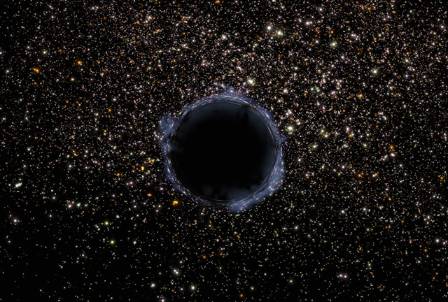
For over a century, black holes have fascinated both scientists and dreamers. These mysterious cosmic objects trap everything that comes too close, even light itself. But some physicists wonder if black holes might be more than just points of no return. Could they actually be gateways to other dimensions or even new universes? The idea may sound like science fiction, but it is based on real scientific theories that researchers are still exploring today.
A Glimpse Into the Unknown
Black holes are formed when massive stars collapse under their own gravity. At the center lies a region scientists call a singularity, where gravity becomes infinite and the known laws of physics no longer apply. Some modern theories suggest that instead of a true singularity, black holes could contain a tunnel through space and time. These hypothetical tunnels, sometimes referred to as wormholes, might lead to far-off parts of the universe—or even to another dimension.
The Role of Quantum Physics
Classical physics says that nothing escapes a black hole. But quantum theory adds new possibilities. Some researchers believe that black holes do not destroy everything they take in, and that information might somehow be preserved or transferred elsewhere. This line of thinking opens up questions about where that information goes, and whether it could point to regions of the universe we cannot currently see.
Wormholes and White Holes
A popular idea in theoretical physics is that black holes might be connected to white holes. A white hole is a region of space that spits out matter and energy, the opposite of what a black hole does. If a black hole is one end of a tunnel and a white hole is the other, then in theory, entering a black hole could allow travel to another point in space or time. So far, white holes have never been observed, but the mathematics behind them fits within Einstein’s theory of relativity.
Science Without Proof—Yet
There is no direct evidence that black holes are portals. Wormholes, white holes, and extra dimensions remain unproven. But the search for answers continues. Scientists are developing better instruments to study black holes more closely, and future discoveries could support or rule out some of these ideas. For now, black holes remain one of the greatest mysteries in space science.
A Universe of Possibilities
Even if black holes are not gateways, exploring the question helps scientists better understand gravity, time, and the structure of the universe. It also reminds us that there is still so much we do not know. Whether or not they lead to other dimensions, black holes invite us to keep looking deeper into the cosmos and to ask big questions about where we came from and where we might be able to go.