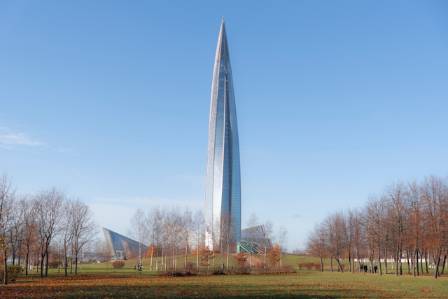
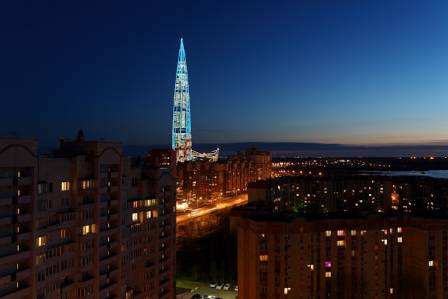
Rising above the skyline of Saint Petersburg, the Lakhta Centre is not just another office tower but a bold architectural statement. Its sail-like silhouette, shimmering glass skin, and record-breaking statistics have made it one of the most distinctive landmarks in modern Europe. Completed in 2018, this mixed-use megastructure is home to offices, shops, cultural venues, and even leisure facilities, creating a self-contained vertical city. Below are six remarkable facts that reveal why this skyscraper is far more than just a tall building.
A Tower That Breaks Records
Standing at an astonishing 462 meters, the Lakhta Centre holds the title of the tallest building in both Russia and Europe. It dominates the Saint Petersburg skyline with a spire that pierces the clouds, making it instantly recognizable from miles away.
Ninety Floors of Activity
The complex contains 90 levels in total, with 87 above ground and three below. Mobility inside the tower is powered by 34 elevators, designed so efficiently that waiting times rarely exceed half a minute. At the very top, visitors can step into an observation deck and restaurant, offering panoramic views once accessible only by airplane.
The Signature Spire
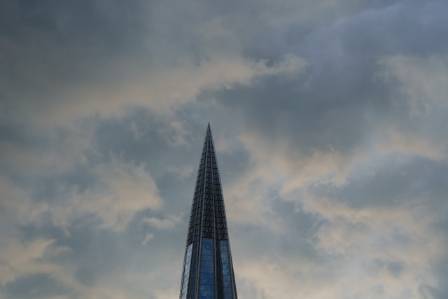
The 104-meter spire crowns the structure, symbolizing the strength and flow of water. Constructing such a feature required extraordinary equipment, including Europe’s tallest crane. To withstand Saint Petersburg’s freezing winters, engineers implemented an anti-icing system to prevent dangerous icicle buildup.
A Guinness World Record Foundation
Supporting a skyscraper of this scale required one of the most impressive foundations ever attempted. Engineers poured 19,624 cubic meters of concrete in a nonstop process lasting more than 49 hours. This feat earned the Lakhta Centre a Guinness World Record for the longest continuous concrete pour in history.
A Living Glass Facade
The exterior is wrapped in 16,500 curved glass panels, making it the largest amount of glass ever used on a high-rise. These panels are fitted with smart shutters and valves to cut down on energy loss. Reflecting the theme of water, the facade changes color with the shifting sunlight, giving the impression of a living, breathing organism.
Years in the Making
The Lakhta Centre took six years to rise from its foundations. From the first concrete pour in 2015 to the topping out of the spire in 2017, the tower became Europe’s tallest structure before it even officially opened. Today, it serves as the headquarters for Gazprom, accommodating thousands of employees and welcoming daily visitors.
Conclusion
The Lakhta Centre is more than a skyscraper; it is a blend of innovation, artistry, and sustainability. With its record-breaking height, state-of-the-art systems, and fluid design, the tower has secured its place as a modern icon of Saint Petersburg. Anyone fascinated by architecture, engineering, or city skylines will find the Lakhta Centre an unforgettable sight.